


Executive Workflows
Spend more time leading and less time managing administrative work
Leadership creates an interesting problem. The more responsibility you have, the more information and administrative work comes your way. Email, meetings, follow-ups, research, proposals, reports, decisions, people asking questions. Individually small. Together, most of the day.
Executive Workflows reduce that operational load using the right combination of automation, AI, process improvement and custom technology.
The objective is not to replace your judgment. It is to give you more time to use it.
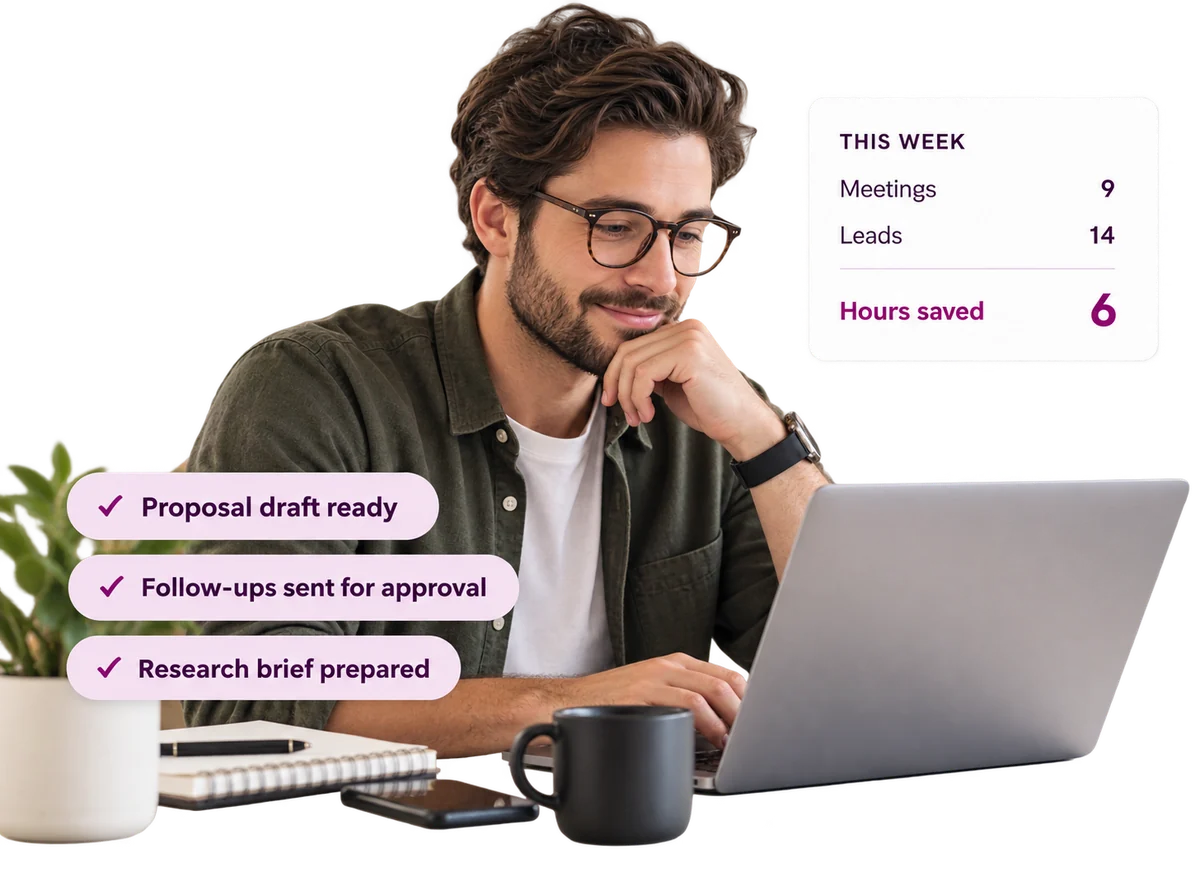
Not another tool to manage
Most executives already have enough software. Adding another application, AI tool or dashboard does not automatically make your day easier.
We look at how you already work, the systems you already use, and the tasks that repeatedly consume your time. Then we determine how those workflows could be improved.
Sometimes that means automation. Sometimes AI can help with research, analysis, drafting or organizing information. Sometimes the process itself needs to be simplified. Often it is a combination.
The goal is not to introduce more technology. The goal is to make the work easier.
Executive workflows we can help improve
A growing library of proven workflows, adapted to how individual leaders work.
These are examples. Every executive works differently, which is why we begin by understanding your workflows rather than assuming which ones should be automated.
Built around how you work
An executive workflow should not force you into someone else's process. We look at things such as:
- Your role and responsibilities
- How your time is currently spent
- Repetitive tasks you handle regularly
- Your priorities and communication style
- The systems and information you already use
- Tasks that frequently interrupt higher-value work
- How you prefer to review and approve work
Humans stay in control
Technology is most useful when it supports good human judgment rather than trying to remove it.
A workflow might gather information, organize it, analyze it, prepare a draft or recommend a next step. Automation handles repetitive work in the background. AI might interpret information or prepare something for your review.
You remain in control of the decisions that matter. The result is less administrative effort without giving up visibility, judgment or accountability.
Start with an Executive Workflow Assessment
You probably have dozens of workflows that are simply part of how you get through the day. The challenge is knowing which ones are worth improving first.
What we look at together
- The recurring workflows you are responsible for
- Which activities consume the most time
- Where you experience the most friction or interruption
- Which tasks are repetitive or unnecessarily manual
- Where information is hard to find or move between systems
- Where delays, missed follow-ups or inconsistencies occur
- Which activities need your judgment, and which technology could support
How we prioritize what comes first
- Time saved and how often the workflow runs
- Amount of administrative effort involved
- Reduction in interruptions and cognitive load
- Risk of missed information or follow-up
- Ease of implementation and potential impact
The purpose is not to automate everything. It is to find the workflows where improvement creates the most meaningful return, implement the highest-value one first, learn from it, and expand over time.
Not every workflow needs AI
For each workflow we consider the most appropriate approach.
What could we take off your plate?
You do not need to know whether the answer is AI, automation or something else. That is what the assessment is designed to determine.
We look at how your work gets done today, identify the biggest opportunities for improvement, and help you prioritize where technology can make the greatest difference.
